
Mold design and engineering
We engineer the mold before we cut any steel.
Our DFM review and mold design catch problems on screen, keep the tool as simple as your part allows, and set it up to run consistently for the life of the program.
How our DFM review works
You send a part. We send back what it will take to mold it well, and what it will cost.
Send a STEP file
Plus your quantity, material if you know it, and any cosmetic requirements.
DFM review
We check draft, wall thickness, undercuts, gate location, and anything that will fight the mold.
Recommendations and quote
You get clear notes on what to change and why, along with a tooling quote.
Final mold design
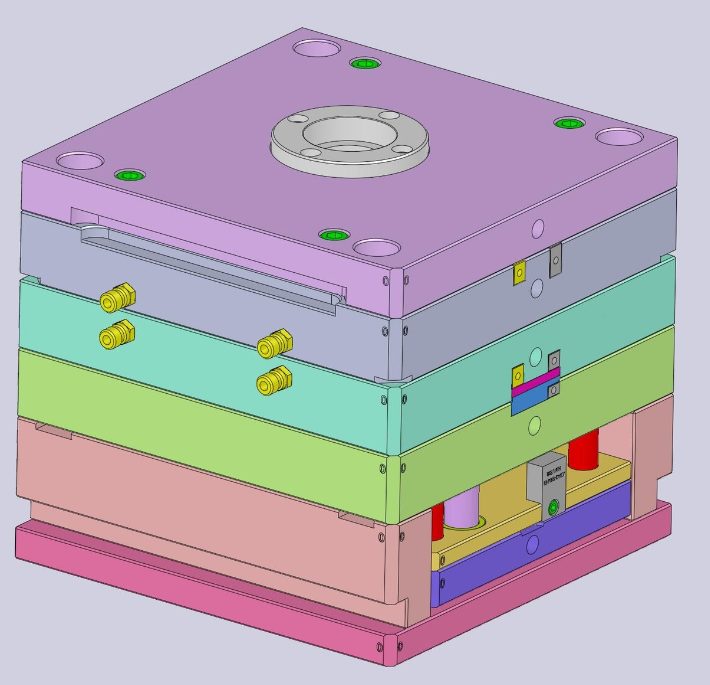
Once the part is settled, we design the full mold in Cimatron and start building.
Why DFM comes before tooling
Most tooling problems show up after the mold is cut: a part that won't eject cleanly, a thick section that warps, or a gate mark on a cosmetic surface. Fixing them then means welding, recutting, and waiting.
The same early decisions also set what the mold costs. Parting line, draft, and gating decide whether your part runs in a simple two-plate mold or needs slides, lifters, and extra plates. Those choices are cheap to change on screen and expensive to change in steel.
What the engineering review covers
Part geometry
Wall thickness, draft angles, undercuts, sharp corners, and features that can't be formed in a straight pull.
Mold design in Cimatron and SolidWorks
Cavity and core layout, runners and gates, cooling, ejection, and electrodes for EDM detail, in software built for mold design.
Resin and steel selection
Resin guidance based on how the part has to perform, and mold steel matched to your expected volume and how abrasive the resin is, such as glass-filled grades.
Clean data transfer
Send a neutral STEP file and keep your native CAD in-house. No format back-and-forth and no need to hand over proprietary models.
Three decisions that drive what your mold costs
Each one is settled before steel is cut. Here's what each controls, and what it costs when it's wrong.
Parting line and draft
The parting line is where the two halves of the mold meet, and it sets the direction the part comes out. Any feature that can't release in that direction needs a side action, a slide or a lifter. Each one adds steel, moving parts, maintenance, and cost.
Draft is the slight taper that lets the part release cleanly. Too little causes drag marks, sticking, and visible ejector marks. Textured surfaces need more draft than polished ones.
Getting both right early often removes a side action from the mold entirely.
Gate location
The gate is where plastic enters the part. Its location decides how the cavity fills, where knit lines form, and where the gate mark ends up. It also decides how the mold is built: a simple two-plate cold runner, a three-plate mold, or a hot runner system.
We settle gating early, weighing upfront tooling cost against the runner material you'd scrap on every shot.
Cooling and cycle time
Cooling is usually the longest part of the molding cycle. The layout of the water lines decides how fast the part can come out and how evenly it shrinks. Uneven cooling shows up as warp and parts that drift out of tolerance.
We design cooling into the mold from the start. A second or two saved per cycle adds up over every shot the mold runs.
Send us a part for a DFM review
Attach a STEP file and tell us your quantity and timeline. We'll come back with what we'd change and what the mold will cost.
Or call Call us